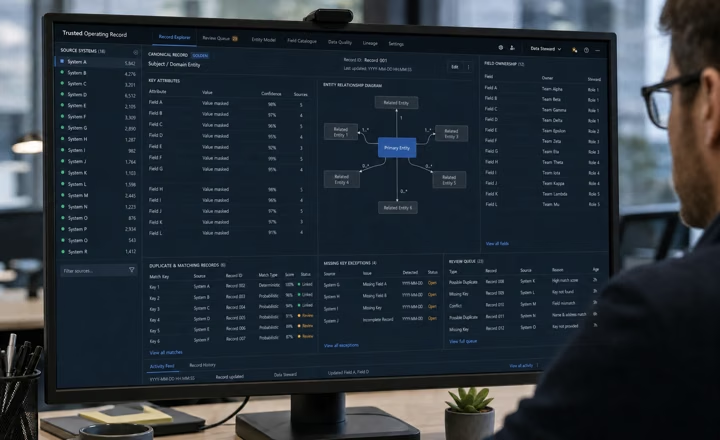
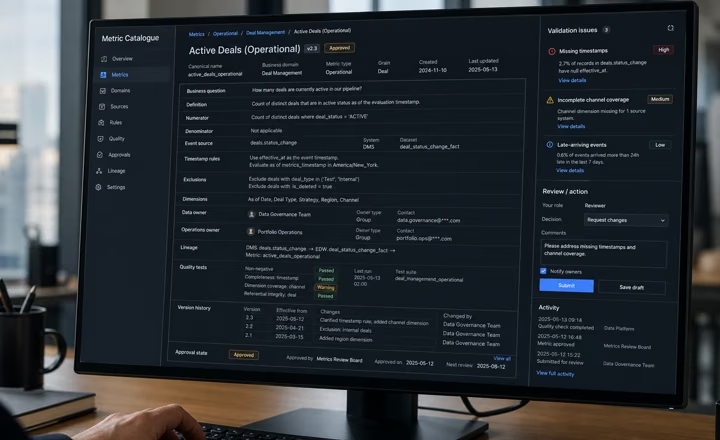
Blackstone Data Control System product interface

VISIBILITY / SERVICE 08

Turn fragmented operational data into decision-ready records, metrics and controlled AI inputs.

Blackstone turns scattered CRM fields, forms, spreadsheets, portal events and reporting logic into a governed operating foundation. Each critical record gains an authoritative source, each management metric gains a documented calculation and owner, and each proposed automation or AI use is bounded by visible quality and permission rules. Leaders receive a clearer basis for action; data and technology teams receive a model they can implement, test and hand over.

  • Decision-owned records
  • Explainable metrics
  • Controlled AI inputs

WHEN THE FOUNDATION BECOMES THE CONSTRAINT

Fix the data foundation when leaders cannot reconcile the same operating question.

01

The same question produces competing answers

Pipeline, service volume, response time or customer status changes with the report, formula, time window or person preparing it. Leadership cannot act confidently because the disagreement sits below the presentation layer.

02

Ownership stops at the system boundary

Teams know where data is stored but not who can approve its meaning, correct a critical field or decide which source controls the next workflow step. Technical access exists without operating accountability.

03

Quality limits remain hidden until use

Missing timestamps, duplicate records, stale states and unsupported channels enter reporting, integration or AI work without a visible exception path. The business discovers the limitation only after a decision depends on it.

BLACKSTONE DATA CONTROL SYSTEM

Source-to-decision data foundation product interface
FOUNDATION WORKSPACE One governed path from operating record to decision evidence Review ready · Illustrative Blackstone system concept · No client data

SOURCE-TO-DECISION FOUNDATION

Build one governed path from source record to management decision.

Blackstone connects the records already created by forms, CRM, portals, operational tools and spreadsheets to one explicit control layer. The work defines which source is authoritative, how records and events are named, who owns material fields, how management metrics are calculated and which quality conditions limit use. The result is a practical data product for one operating decision, not an open-ended warehouse programme.

  1. 01

    Operating record

    Define the customer, request, owner, status and evidence entities required by the first decision.

  2. 02

    Source authority

    Assign the controlling system and accountable owner for every material field and state.

  3. 03

    Event semantics

    Name the business events, timestamps and exception states that make workflow change observable.

  4. 04

    Metric contracts

    Document the question, formula, grain, source, owner, cadence and known limitations for each KPI.

  5. 05

    Quality evidence

    Test completeness, validity, consistency, uniqueness and timeliness where they affect the intended use.

  6. 06

    Use eligibility

    Classify approved, review-only and blocked data for reporting, integrations, automation and AI.

Data-use boundary

The foundation makes definitions, ownership and quality limits reviewable. It does not make incomplete historical records accurate, resolve legal obligations without specialist review or make data suitable for every future use.

THREE FOCUSED DATA COMMISSIONS

Commission the smallest data foundation that makes one decision dependable.

Blackstone does not begin with a platform-wide transformation. The first commission is chosen around the decision currently losing time, trust or control, then bounded to the records, definitions and evidence required to improve it.

Operating record and source-authority product interface
RECORD EXPLORER One operating record Ownership mapped · Illustrative Blackstone system concept · No client data

TRUSTED OPERATING RECORD

Establish the operating record and ownership model that connected systems can rely on.

Blackstone maps how customer, request, owner, status and evidence records currently move between CRM, forms, portals, spreadsheets and backend tools. We then define the canonical record family, valid states, material relationships and authoritative field sources for one workflow. Business ownership is separated from technical custody so the organisation can see who approves meaning, who maintains the system and who resolves an exception. The result is not a shadow database. It is a durable record contract that gives later portals, integrations and reporting work a common operating language.

Current technical scope
  1. 01
    Canonical operating model

    Define the first record family, relationships, required fields and valid business states.

  2. 02
    Source and ownership register

    Assign authoritative systems plus Business, Data and Technical ownership for material fields.

  3. 03
    State and recovery contract

    Document validation, export, retention notes and the minimum recoverable handover.

Commission this first when

Customer, request, owner or status fields disagree across systems and staff cannot identify which record should control the next action.

First Blackstone deliverable

A working record model, source-authority map, ownership register, state rules, sample validation and recoverable handover for the first workflow.

Control boundary

Historical completeness remains an explicit limitation. Unresolved ownership, duplicate identities and unsupported states are not silently normalised.

Value protected
Decision continuity
Give connected services one accepted record and state language.
Accountable correction
Make approval, maintenance and exception ownership explicit.
Integration readiness
Reduce ambiguity before portals, sync or reporting work expands.
Operating evidence No target before baseline
Outcome Authoritative-field coverage
Material fields in scope with an accepted controlling source and named owner.
Driver Ownership decisions resolved
Required source and field-ownership decisions accepted for the first workflow.
Guardrail Conflicting-state exception rate
In-scope records still presenting duplicate or incompatible operating states.
Discuss Trusted Records
Metric contract and event catalogue product interface
METRIC CATALOGUE Definitions before dashboards Contract reviewed · Illustrative Blackstone system concept · No client data

DECISION-READY METRICS

Give every management metric a definition, source, owner and review rule.

Blackstone begins with the operating questions leadership is expected to answer, then traces each question to the records, events and calculation rules required to support it. Every metric receives a documented grain, formula, inclusion logic, time window, source, accountable owner and review cadence. Event names are aligned to real workflow transitions rather than page-level noise, while missing coverage and known caveats remain visible beside the result. The first dashboard therefore becomes evidence of a governed measurement system, not a new presentation layer over competing spreadsheet logic.

Current technical scope
  1. 01
    Metric contract catalogue

    Document question, grain, formula, inclusion logic, source, owner and review cadence.

  2. 02
    Semantic event plan

    Name the workflow transitions, timestamps and exception events needed by each decision.

  3. 03
    Lineage and evidence notes

    Connect the result to source coverage, quality tests, caveats and accepted change history.

Commission this first when

Pipeline, workload, response time or service quality changes with the report because definitions and event coverage are not shared.

First Blackstone deliverable

A metric contract set, event taxonomy, source map, instrumentation specification and one reviewable management view.

Control boundary

A metric is not described as reliable until its calculation, source coverage, owner and known limitations have been reviewed.

Value protected
Comparable reporting
Use accepted calculation rules across management views.
Faster investigation
Trace disagreement to source, coverage or definition instead of presentation.
Governed change
Keep formula and source decisions visible and assigned.
Operating evidence No target before baseline
Outcome Governed-metric coverage
Metrics in the first operating view with accepted contracts and owners.
Driver Required-event coverage
Decision-critical events captured using the agreed names and required attributes.
Guardrail Definition conflict count
Metrics that retain competing formulas, time windows or source rules.
Discuss Decision Metrics
Data quality and AI eligibility product interface
USE ELIGIBILITY A boundary for each intended use Named review · Illustrative Blackstone system concept · No client data

CONTROLLED DATA FOR AI

Separate eligible, review-only and blocked data before AI or automation expands.

Blackstone defines the data boundary around one proposed automation or reviewed AI workflow before a model or tool is allowed to rely on it. Fields and document sources are classified by purpose, sensitivity, quality and accountable owner; missing, stale, duplicate and invalid conditions receive explicit review paths. Approved data can be used only for the documented task, review-only material pauses for named judgement and blocked information remains outside the workflow. This creates an evidence base for a bounded pilot while preserving the difference between technical availability and authorised, suitable use.

Current technical scope
  1. 01
    Quality-rule set

    Test missing, duplicate, stale, invalid and unsupported states for the intended use.

  2. 02
    Classification and eligibility

    Separate approved, review-only and blocked fields, documents and derived data.

  3. 03
    Provenance and approval evidence

    Record source, purpose, owner, limitations, approval and change-control decisions.

Commission this first when

An AI, integration or automation initiative is advancing before the business can explain which data is suitable, sensitive, unsupported or review-only.

First Blackstone deliverable

A classified source inventory, quality exception register, permitted-use model, approval workflow and evaluated first-use data boundary.

Control boundary

Classification supports governance but does not guarantee legal sufficiency, model accuracy or suitability beyond the documented use case.

Value protected
Controlled expansion
Bound the first use before adding tools, data classes or decisions.
Visible data risk
Keep unsupported and sensitive inputs outside unapproved paths.
Reviewable AI inputs
Preserve purpose, provenance, owner and approval evidence.
Operating evidence No target before baseline
Outcome Use-eligibility coverage
In-scope fields and sources classified for the documented intended use.
Driver Quality-rule coverage
Critical data states tested against the accepted quality conditions.
Guardrail Unreviewed eligibility changes
Permitted-use changes made without the required named approval.
Discuss Controlled AI Data

CONTROLLED DATA OPERATING CASE

Make every important signal traceable to its record, definition and accountable owner.

A useful foundation lets a business leader understand what a signal means and lets a data or technology owner prove where it came from. Blackstone connects business questions to source records, semantic definitions, quality evidence, permitted use and named review so one operating view can be trusted within clearly stated limits.

Decision question to operated evidence

  1. 01

    Qualify decision

    Agree the user, business question, cadence and first useful operating view.

  2. 02

    Map sources

    Trace records, events, transformations, gaps and current decisions.

  3. 03

    Define contract

    Set record, metric, ownership and intended-use rules.

  4. 04

    Test quality

    Evaluate coverage, validity, uniqueness, timeliness and exceptions.

  5. 05

    Release view

    Deliver one dashboard, CRM view or reviewed data workflow.

  6. 06

    Operate change

    Hand over monitoring, approval, review cadence and backlog.

Permitted foundation work

  • Define records, relationships, states and semantic events
  • Implement metric, lineage and quality contracts
  • Document ownership, permissions and intended-use eligibility

Named review required

  • Authoritative-source, metric-formula or grain changes
  • Sensitive, restricted or AI-eligible data decisions
  • Expansion beyond the accepted decision and record family
Exception path
A missing owner, source, formula, coverage test or permission boundary blocks release or produces a narrower first operating view.
Named owners
Business Owner accepts decision meaning; Data Owner controls definition and quality; Technical Owner operates implementation; Review Owner approves restricted use.
Handover evidence
Record dictionary, source register, metric contracts, event specification, quality results, eligibility decisions and change history remain reviewable after handover.

DECISION EVIDENCE SPREAD

See whether a data signal is ready to support a decision.

A dashboard value is useful only when the buyer can understand its question, source, definition, quality limits, owner and permitted use. This illustrative contract shows the evidence Blackstone makes visible before a metric enters an operating review.

Business question
How quickly does a new service request reach an accountable owner?
Illustrative signal
Request-to-owner latency
  1. 01

    Source

    Controlled request events

    request.created and request.owner_assigned from the accepted request record.

  2. 02

    Definition

    Request-level elapsed time

    Owner-assigned timestamp minus request-created timestamp at request grain.

  3. 03

    Quality

    Coverage and exceptions

    Check missing timestamps, duplicate assignments, unsupported channels and reopened requests.

  4. 04

    Owner

    Operations plus Data

    Operations approves use; Data controls definition and source changes.

  5. 05

    Permitted use

    Management trend review

    Use for routing investigation after event coverage is validated.

  6. 06

    Decision

    Route and assign work

    Review intake routing, assignment rules and where staffing attention is required.

FIRST-COMMISSION DECISION MATRIX

Choose the first commission by the decision that currently lacks reliable evidence.

The first implementation should prove one management or operating use, not attempt to repair the entire data estate. Compare the blocked decision, required records, accountable control and evidence each commission must produce.

01

Executive Operating View

Decision problem
Pipeline, capacity and service signals change with the report or presenter.
Required records
Owned operating records, semantic events and accepted metric contracts.
Accountable control
Business and Data Owners approve definitions, caveats and change rules.
First implementation
One management dashboard or operating review surface.
Evidence to review
Definition coverage, event coverage, quality exceptions and accepted changes.
Blackstone deliverable
Governed metric contracts and one decision-ready operating view.
02

CRM and Portal Record

Decision problem
Customer, request, owner and status data diverge across connected systems.
Required records
CRM, form, portal and backend records within one accepted workflow.
Accountable control
Field owners approve source authority, valid states and exception handling.
First implementation
One CRM, portal or backend record family.
Evidence to review
Authority coverage, conflicting states, record completeness and ownership decisions.
Blackstone deliverable
Canonical operating record and source-authority contract.
03

Controlled AI Data Boundary

Decision problem
The business cannot explain which sources are suitable, sensitive or review-only.
Required records
Classified fields, documented sources, quality results and intended-use rules.
Accountable control
Named review approves eligibility, restricted data and boundary changes.
First implementation
One bounded automation or reviewed AI workflow.
Evidence to review
Classification coverage, quality exceptions, provenance and approval history.
Blackstone deliverable
Permitted-use, quality and AI-data eligibility register.
04

Analytics Recovery

Decision problem
Spreadsheet and dashboard logic cannot be maintained, compared or explained.
Required records
Current formulas, source extracts, field maps and documented exceptions.
Accountable control
Metric owners accept replacement contracts and known limitations.
First implementation
One recovered dashboard or reporting workflow.
Evidence to review
Formula conflicts, missing inputs, source coverage and accepted replacement logic.
Blackstone deliverable
Replacement metric contracts and analytics recovery runbook.

COMMISSIONING ROADMAP

Move from disputed data to an operated first data product.

Blackstone keeps the first release tied to one decision and one accountable record family. Each gate produces an artefact the next gate can test, so scope expands from evidence rather than architecture ambition.

  1. 01

    Qualify

    Agree the business decision, users, review cadence, risk and smallest useful operating view.

    Phase output Accepted decision brief
  2. 02

    Model

    Map sources and define records, fields, states, events and accountable ownership.

    Phase output Record and source contract
  3. 03

    Govern

    Document metric definitions, quality rules, permissions, eligibility and exception paths.

    Phase output Control and evidence register
  4. 04

    Prove

    Implement one dashboard, CRM view or reviewed data workflow and test real operating cases.

    Phase output Validated first operating view
  5. 05

    Operate

    Hand over documentation, monitoring, change control and a prioritised expansion backlog.

    Phase output Operated data-product handover

DATA SYSTEMS REVIEW FAQ

Practical answers before a data foundation review.

The review identifies the decision, record family, ownership and evidence that justify a focused first commission. It does not assume a warehouse replacement or platform migration.

Bring the decision your current data cannot support consistently.

Blackstone will identify the smallest record model, metric contract and ownership boundary required to turn that decision into a controlled first operating view.

Bounded use case Named review owner Evidence before expansion
Focus

Do not include credentials, private exports, customer records or sensitive personal data.