Enterprise cloud operations workspace showing controlled releases, service health and recovery evidence

CLOUD OPERATIONS / SERVICE 14

Cloud operations that keep releases, service health and recovery accountable after launch.

Blackstone designs the operating layer around the cloud services and connected applications your business already depends on. Mobile, web and desktop surfaces can share approved APIs, workflow records and operating evidence without sharing the same access. Environments, deployment approvals, user-facing health signals, incident ownership, restore paths and cost reviews are brought into one accountable model. The objective is not more infrastructure for its own sake; it is a controlled way to change, observe and recover critical systems without relying on private knowledge or provider dashboards alone.

  • Controlled change
  • Owned incidents
  • Verified recovery

WHEN TO COMMISSION

Fix the operating layer when the system is live but accountability is still informal.

01

Production changes depend on memory

Deployments, configuration changes and rollback decisions rely on individual knowledge rather than a reviewable release path.

02

Monitoring stops at infrastructure health

Provider dashboards may remain green while a customer journey, integration or business record is already failing.

03

Recovery and cost decisions lack ownership

Backups exist without restore evidence, while cloud cost and resilience choices are not connected to business criticality.

CLOUD OPERATIONS CONTROL SYSTEM
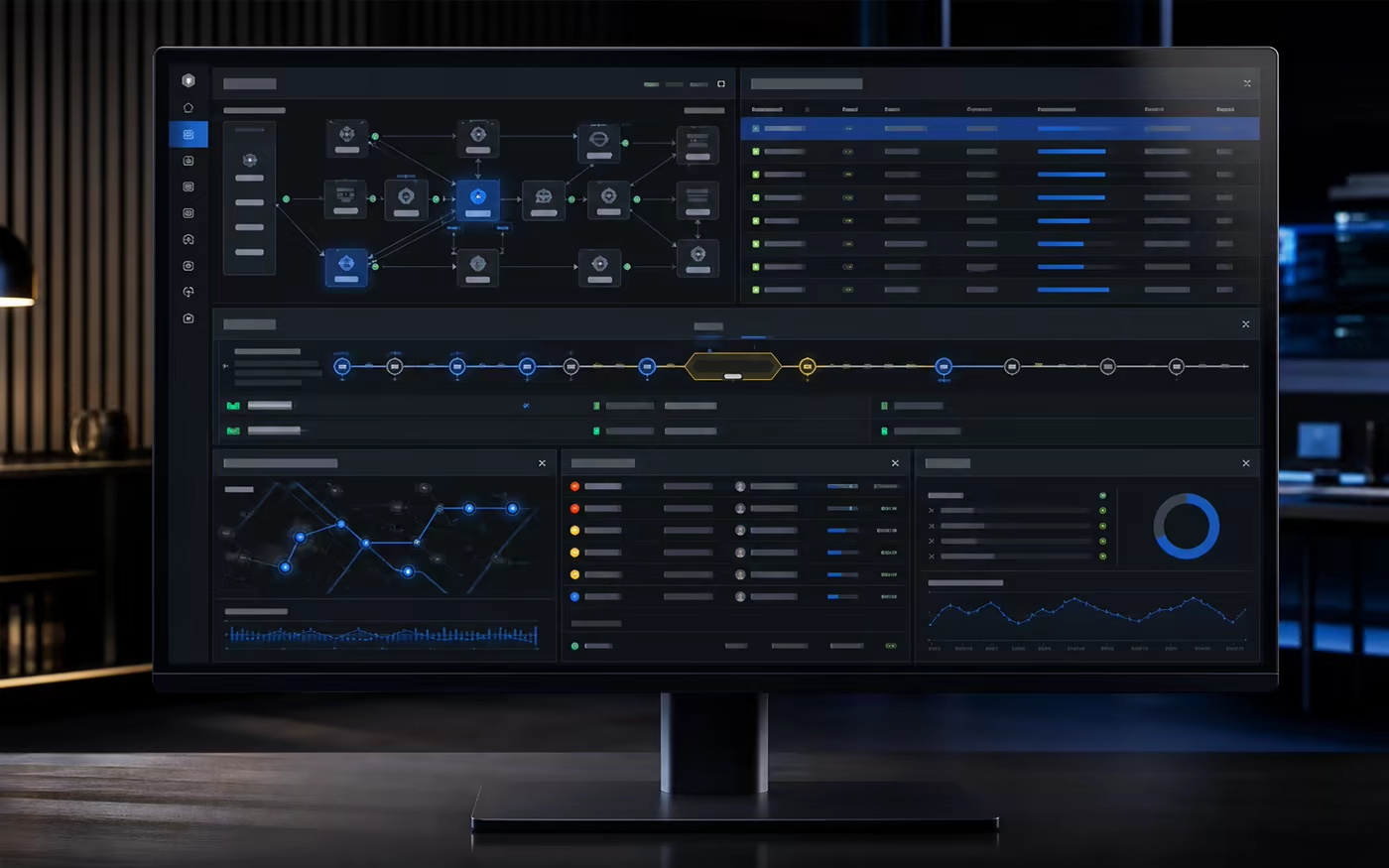
Cloud operations control board with release gates, service health, incident routing and recovery evidence
CLOUD OPERATIONS CONTROL SYSTEM One accountable path from production change to service review Review ready · Illustrative Blackstone system concept · No client data

SERVICE OPERATING MODEL

Connect every critical service path to a release gate, health signal, incident owner and tested recovery route.

Blackstone turns application surfaces, identity services, APIs, provider accounts, deployment tools, telemetry, incident routines and recovery evidence into one operating model. Leadership can see what the business depends on; technical owners can see which change, alert or recovery action is permitted; and every exception has a named escalation route.

  1. 01

    Critical service map

    Connect mobile, web and desktop journeys to the identities, APIs, integrations and data they require.

  2. 02

    Environment register

    Record production, staging, dependencies, access ownership and provider responsibility.

  3. 03

    Release and rollback control

    Define approved artifacts, decision gates, evidence and a reversible path for production change.

  4. 04

    Customer-path observability

    Measure whether the service completes the task users depend on, not only whether infrastructure is online.

  5. 05

    Incident ownership

    Route actionable signals to a named owner, escalation threshold and communication decision.

  6. 06

    Recovery and cost evidence

    Join restore tests, recovery limits, operating cost and service criticality in one review cadence.

Shared-responsibility boundary

The cloud provider operates its platform. Blackstone defines the customer-side operating model for workload configuration, release, observability, ownership, recovery and evidence.

CONNECTED APPLICATION CASE / PRIVATE MEDICAL

One governed cloud foundation can connect the patient app, secure web portal and staff desktop without giving every user the same access.

For a private medical practice, the commercial problem is rarely one missing screen. Patient intent begins on mobile or web, staff continue the work from operational queues, and management needs evidence that every request, document and follow-up remains owned. Blackstone designs the three surfaces around shared APIs, workflow records, notifications and operating telemetry while keeping customer, workforce and privileged administration identities separate.

Blackstone Connected Practice Control showing a patient mobile app, secure web portal and staff desktop linked to one governed workflow foundation
BLACKSTONE DIGITAL Connected Practice Control
Governed application ecosystem
01 Patient Mobile App
02 Secure Patient and Referrer Web App
03 Staff and Administration Desktop App

SHARED CLOUD FOUNDATION

One operating record. Separate trust boundaries.

The applications reuse the same approved service layer and record model, while each user population receives only the access, recovery path and decision authority required for its task.

EXTERNAL TRUST Customer identity Patient-specific access
WORKFORCE TRUST Workforce identity Role-specific queues
PRIVILEGED TRUST Administration gates Step-up decisions
  • Customer identity
  • Workforce identity
  • Privileged administration
  • API and workflow layer
  • Request and appointment record
  • Permitted document references
  • Notification state
  • Audit, telemetry and recovery evidence
01

Patient Mobile App

Keep appointment access and follow-up available on the device patients already use.

Patients can request or reschedule an appointment, receive preparation instructions, confirm permitted details and follow the next non-clinical step. Each action creates or updates the same owned workflow record used by the practice instead of becoming an isolated message, notification or inbox task.

Identity boundary
Customer identity with patient-specific access.
Human and data gate
No diagnosis, treatment decision or unrestricted record access.
Operating evidence
Request completion, handoff latency and sign-in recovery.
Explore iOS App Development
02

Secure Patient and Referrer Web App

Give patients and approved referrers a structured path for requests, documents and status.

Patients and approved referrers can submit structured inquiries, provide permitted documents, confirm context and view a controlled next-step status without calling reception for every update. The web app uses the same API and record model as mobile while applying its own identity, consent and document-access rules.

Identity boundary
Customer or approved external identity.
Human and data gate
No workforce view, silent data sharing or unverified information release.
Operating evidence
Submission completion, document validation and unresolved-request age.
Explore Web Apps and Business Systems
03

Staff and Administration Desktop App

Turn patient requests into role-specific queues, decisions and accountable follow-up.

Reception, specialist teams and practice management work from role-specific queues for appointment ownership, document review, exceptions, approvals and customer communication. Privileged administration is separated from ordinary staff work, while every consequential action remains attributable to a named user and operating record.

Identity boundary
Workforce identity with additional privileged administration gates.
Human and data gate
Clinical judgment, privileged configuration and external release remain human decisions.
Operating evidence
Assignment time, approval latency and access-control exceptions.
Explore macOS Applications

APPLICATION AND TRUST COMPARISON

Three operating surfaces. One shared record. Different authority at every boundary.

Comparison Patient Mobile AppSecure Patient and Referrer Web AppStaff and Administration Desktop App
Primary user PatientPatient or approved referrerReception, specialist staff and management
Primary job Appointment and follow-upStructured request and documentsOwnership, review and exceptions
Identity boundary Customer identityExternal identity and consentWorkforce identity and admin step-up
Shared record Request or appointment IDSame record plus documentsOwner, status, decision and audit
Human gate No medical adviceSensitive release requires reviewClinical and privileged decisions
Evidence Completion and handoffValidation and unresolved ageAssignment and approval latency

Patient Mobile App

Primary user
Patient
Primary job
Appointment and follow-up
Identity boundary
Customer identity
Shared record
Request or appointment ID
Human gate
No medical advice
Evidence
Completion and handoff

Secure Patient and Referrer Web App

Primary user
Patient or approved referrer
Primary job
Structured request and documents
Identity boundary
External identity and consent
Shared record
Same record plus documents
Human gate
Sensitive release requires review
Evidence
Validation and unresolved age

Staff and Administration Desktop App

Primary user
Reception, specialist staff and management
Primary job
Ownership, review and exceptions
Identity boundary
Workforce identity and admin step-up
Shared record
Owner, status, decision and audit
Human gate
Clinical and privileged decisions
Evidence
Assignment and approval latency

Investment rationale

Commission one governed foundation before three disconnected applications reproduce identity rules, ownership logic and operating records separately. The value case is controlled expansion, service continuity and reusable operating capacity, not an unsupported ROI promise.

Outcome
Owned digital request completion rateDigital requests that reach a completed or explicitly resolved operating state.
Driver
Cross-surface handoff timeElapsed time from an external request to accountable workforce ownership.
Guardrail
Access-control exception rateAccess attempts or actions that require correction, denial or policy review.
Discuss a Connected Application System

Illustrative boundaryIllustrative private-practice case only. Legal basis, consent, identity assurance, retention, clinical-system integration, accessibility and regulatory controls require client-specific validation. FHIR is considered only where an existing clinical system and approved exchange use case support it.

FOCUSED CLOUD OPERATIONS COMMISSIONS

Commission the operating layer that protects the system after release.

Start with the control gap that creates the greatest customer impact, recovery uncertainty or dependence on individual staff.
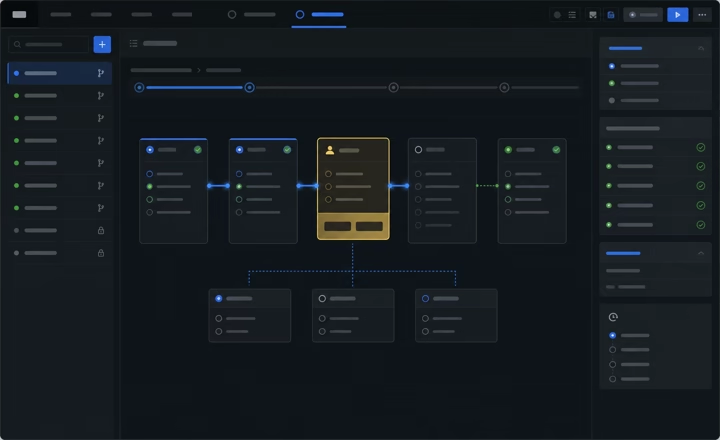
Enterprise release control interface with approval gate and rollback evidence
RELEASE CONTROL Approved change with a visible rollback route Decision ready · Illustrative Blackstone system concept · No client data

RELEASE AND ENVIRONMENT CONTROL

Make production changes repeatable, approved and reversible.

Blackstone turns deployment from a sequence known by one engineer into a controlled release path. Environments, dependencies, configuration boundaries and approval owners are mapped before production change. Each release records what changed, who approved it, which checks passed and which rollback route remains available. Automation can prepare and execute permitted steps, but access changes, irreversible data actions and exceptional releases remain explicit decisions.

Current technical scope
  1. 01
    Environment and dependency register

    Make production, staging, connected services, access ownership and provider boundaries reviewable.

  2. 02
    Release evidence

    Record the artifact, checks, decision owner and resulting production state for every governed change.

  3. 03
    Approval and rollback gates

    Define when a release may proceed, pause or return through a tested reversible path.

Commission this first when

Releases depend on personal memory, manual provider-console work or an unclear fallback decision when production behavior changes.

First Blackstone deliverable

A production-ready environment map, release workflow, approval matrix and tested rollback runbook.

Control boundary

No unapproved production access, irreversible data mutation or silent configuration change enters the release path.
Value protected
Release confidence
Give every production change a reviewable state, decision owner and fallback route.
Customer continuity
Reduce avoidable disruption by connecting change evidence to the service paths customers use.
Technical capacity
Replace repeated reconstruction and manual coordination with a maintained operating path.
Operating evidence No target before baseline
Outcome Successful production change rate
Production changes completed without service-impacting remediation, divided by governed production changes.
Driver Change lead time
Elapsed time from an approved change entering the release path to verified production completion.
Guardrail Change fail rate
Production changes that require rollback, urgent correction or service restoration, divided by governed changes.
Discuss Release Control
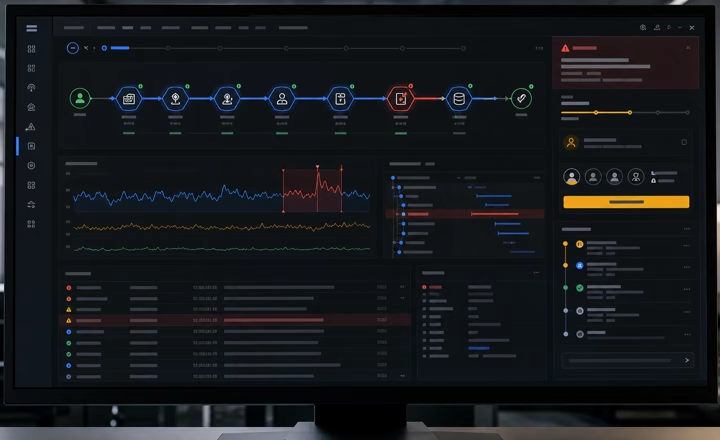
Enterprise service health interface with telemetry, incident routing and owner state
SERVICE HEALTH User-path evidence routed to an accountable response Owner assigned · Illustrative Blackstone system concept · No client data

SERVICE HEALTH AND INCIDENT READINESS

Turn technical signals into an owned response before customer impact becomes invisible.

Blackstone defines observability around the service paths customers and staff actually use. Logs, metrics and traces are connected to a small set of actionable signals, while noisy alerts are separated from events that require intervention. Each critical condition receives a named owner, escalation threshold, evidence requirement and communication decision. The result is not a larger monitoring console; it is a faster path from abnormal behavior to accountable action.

Current technical scope
  1. 01
    Critical-path service indicators

    Measure completion, latency and failure from the perspective of the customer or staff task.

  2. 02
    Telemetry and alert contract

    Connect logs, metrics and traces to thresholds that produce an actionable operating decision.

  3. 03
    Incident ownership route

    Assign detection, escalation, communication and closure to named roles and evidence states.

Commission this first when

Alerts are noisy, customer-facing failures appear before technical teams can explain them, or escalation depends on who notices first.

First Blackstone deliverable

A critical-path observability model, alert catalogue, ownership matrix and incident-response prototype.

Control boundary

No automatic customer communication, destructive remediation or access elevation occurs without defined authority.
Value protected
Service continuity
Detect the failure of a valuable user path before infrastructure-only signals hide the impact.
Customer trust
Connect incident state and communication authority to one accountable operating response.
Response capacity
Reduce alert noise and direct technical attention toward conditions that require action.
Operating evidence No target before baseline
Outcome Customer-impacting incident resolution time
Elapsed time from confirmed customer-path impact to validated restoration and accountable closure.
Driver Alert-to-owner assignment time
Elapsed time from an actionable signal to acceptance by the accountable response owner.
Guardrail Non-actionable alert share
Alerts closed without a required intervention, divided by alerts entering the operating queue.
Discuss Service Health
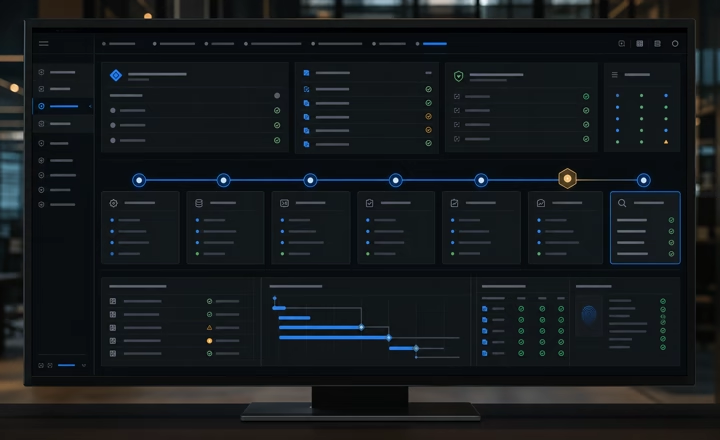
Enterprise recovery readiness interface with restore drill and integrity evidence
RECOVERY READINESS Restore evidence measured against approved business limits Validation required · Illustrative Blackstone system concept · No client data

RECOVERY AND CONTINUITY

Prove that critical data and service paths can be restored within business-approved limits.

Blackstone converts backup settings into a controlled recovery capability. Business owners define which services and records matter, how much interruption or data loss can be tolerated and who can activate recovery. Technical teams receive a documented restore path, validation rules and evidence from rehearsed recovery. Cost and complexity are reviewed against actual criticality so resilience is neither assumed nor over-engineered.

Current technical scope
  1. 01
    Criticality and recovery objectives

    Connect tolerated interruption and data loss to the business service and accountable owner.

  2. 02
    Restore workflow and validation

    Define the recovery route, integrity checks, elapsed-time evidence and accepted completion state.

  3. 03
    Rehearsal and review cadence

    Test the path, record exceptions and review resilience depth against operating cost.

Commission this first when

Backups exist but restore integrity, elapsed time, ownership or customer-impact decisions have not been tested.

First Blackstone deliverable

A recovery decision brief, restore runbook, controlled drill and evidence register.

Control boundary

No disaster declaration, production failover or destructive restore proceeds without named authorization.

Value protected
Business continuity
Tie recovery depth and operating decisions to the service the business must restore.
Record integrity
Validate that restored data is accessible, complete enough and fit for the agreed recovery state.
Proportionate resilience
Review cost and technical complexity against actual criticality instead of assuming maximum redundancy.
Operating evidence No target before baseline
Outcome Verified recovery completion rate
Recovery exercises reaching the approved service and integrity state, divided by completed recovery exercises.
Driver Restore elapsed time
Elapsed time from authorized recovery start to validated service and data availability.
Guardrail Recovery integrity exception rate
Recovery exercises with missing, corrupt, inaccessible or out-of-bound data, divided by completed exercises.
Discuss Recovery Readiness

CONTROLLED OPERATING CASE

Run changes, detection, response and recovery as one controlled operating system.

A reliable operating model connects business criticality to technical action and retains evidence for every consequential decision.

Business criticality to operating review

  1. 01

    Business criticality

    The customer or staff service and its accepted exposure are defined.

  2. 02

    Environment state

    Dependencies, access, configuration and provider boundaries remain visible.

  3. 03

    Approved change

    The artifact, checks, decision owner and rollback route are recorded.

  4. 04

    User-path health

    Telemetry shows whether the service completes the task users depend on.

  5. 05

    Incident action

    An actionable condition reaches the accountable owner and authority route.

  6. 06

    Recovery and review

    Restoration, integrity, cost and improvement evidence remain inspectable.

Permitted operating actions

  • Execute an approved deployment and collect its release evidence
  • Route an actionable signal to the named response owner
  • Initiate a documented rollback or restore within predefined authority

Explicit human gates

  • Production access, DNS, network or irreversible data changes
  • Disaster activation, contractual commitments or customer communication
  • Recovery results that fail integrity or accepted service limits
Exception path
Unclassified dependencies, missing evidence or failed validation return to technical review before release or recovery continues.
Named owners
Business service owner, technical owner, operations owner and escalation authority.
Operating evidence
Environment map, release record, telemetry trace, incident timeline, restore result and post-event action register.

OPERATING EVIDENCE

Can the business prove that a critical service path is ready to operate?

Readiness becomes visible only when one user-critical path can be traced from production change to service review.

Decision question
Can one critical service be traced from approved change to validated recovery?
Readiness signal
Owner + evidence + permitted action
  1. 01

    SERVICE PATH

    Critical service path

    Name the customer or staff task, its business owner and the impact if it fails.

  2. 02

    CHANGE

    Release evidence

    Record the artifact, approval, checks, resulting state and available rollback route.

  3. 03

    OBSERVABILITY

    Service health

    Connect user-perspective indicators to the traces, metrics and logs needed to explain behavior.

  4. 04

    RESPONSE

    Incident ownership

    Define the alert recipient, escalation threshold, decision authority and communication owner.

  5. 05

    CONTINUITY

    Recovery proof

    Validate restoration, data integrity, elapsed time and accepted data loss against approved limits.

  6. 06

    REVIEW

    Cost and service review

    Compare operating spend, resilience depth, service behavior and the improvement backlog.

CLOUD OPERATIONS COMMISSION MATRIX

Choose the first cloud operations commission by the business exposure it must protect.

The right first commission is selected by the service path, operating consequence and missing decision evidence, not by the broadest possible tooling programme.

01

Public Website Operations

Value exposed
Inquiry continuity, trust and campaign response.
First commission
Release control and critical-path monitoring.
Control gate
DNS, production and rollback approval.
Required integration
Hosting, deployment pipeline, DNS and inquiry path.
Evidence to track
Page or task success, failed changes and incident ownership.
First deliverable
Website operations blueprint.
02

Connected Application Operations

Value exposed
Customer task completion, staff capacity, identity boundaries and operating records.
First commission
Shared API, identity and critical-path operating model.
Control gate
Access, integration, privileged administration and data-change approval.
Required integration
Mobile, web and desktop applications, identity, API, database and support queue.
Evidence to track
Cross-surface completion, assignment time, access exceptions and recovery evidence.
First deliverable
Connected application operations blueprint.
03

Backend and Data Continuity

Value exposed
Staff capacity, record integrity and reliable follow-up.
First commission
Recovery and continuity.
Control gate
Restore validation and irreversible-action approval.
Required integration
Data stores, scheduled jobs, backups and dependent systems.
Evidence to track
Backup integrity, restore elapsed time and unresolved job failures.
First deliverable
Continuity and restore plan.
04

Cost and Performance Governance

Value exposed
Margin, capacity and predictable operating spend.
First commission
Cost and service review.
Control gate
Capacity or architecture-change approval.
Required integration
Billing export, resource inventory and service telemetry.
Evidence to track
Allocated cost, utilization and user-path performance.
First deliverable
Cost and performance decision brief.

DELIVERY AND HANDOVER ROADMAP

Move from provider accounts and informal routines to an operated service model.

Blackstone commissions one critical service path first, proves the operating controls and hands over the owners, evidence and review cadence needed for continued operation.

  1. 01

    Classify

    Identify critical services, business impact, decision owners and acceptable operating boundaries.

    Phase output Criticality brief
  2. 02

    Map

    Document environments, dependencies, access, providers and shared-responsibility boundaries.

    Phase output Environment and dependency map
  3. 03

    Instrument

    Define release evidence, user-path signals, alerts and ownership routes.

    Phase output Monitored release path
  4. 04

    Rehearse

    Test rollback, incident escalation, restore validation and communication gates.

    Phase output Drill and evidence record
  5. 05

    Operate

    Hand over cadence, reviews, runbooks, cost decisions and improvement backlog.

    Phase output Cloud operations handbook

CLOUD OPERATIONS REVIEW FAQ

Practical answers before a cloud operations review.

The review decides which service path requires control first, where responsibility sits and what evidence must exist before scope expands.

Bring the system whose hosting, release or recovery ownership is still unclear.

Blackstone will identify the critical service path, the control gap creating the greatest exposure and the smallest operating commission capable of producing useful evidence.

Bounded use case Named review owner Evidence before expansion
Focus

Do not include credentials, access tokens, production secrets or confidential incident records.