Offer clarity before action
Customers can understand the package, price logic, availability, next step and expected outcome before they start a booking, quote or checkout path.
Presentation / Service 15
A good digital sales flow helps customers understand the offer, make a request, book a service or start a conversation without unnecessary friction.
Overview
Digital sales does not always mean a full online shop. Many companies need a clearer path from discovery to inquiry, booking, quote request or follow-up. The page, form, confirmation and handover should all use the same logic.
Revenue flow preview
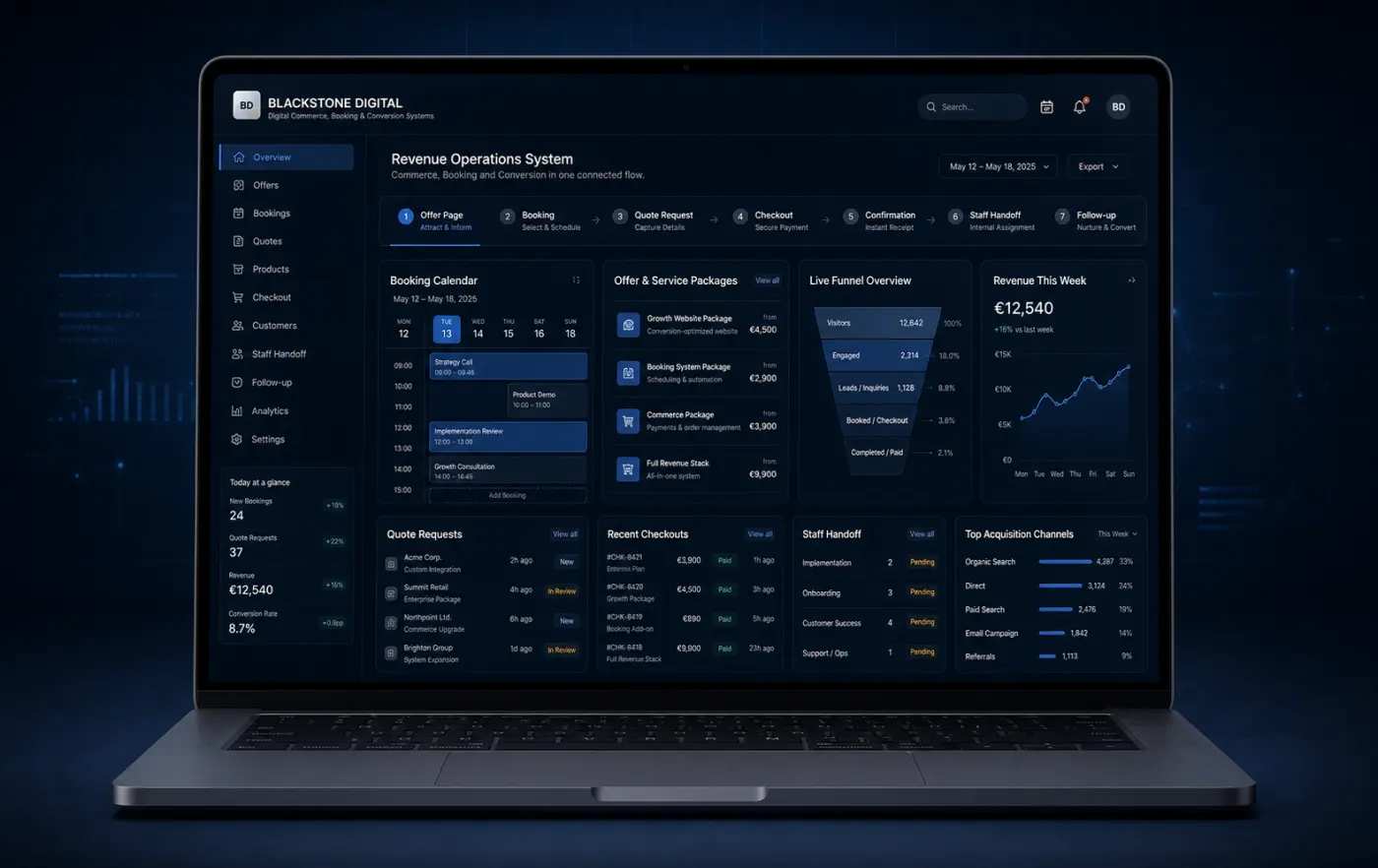
Commerce, booking and conversion systems case study
For a revenue-facing service, the website is not just a page with a form. It is the path from offer clarity to booking, quote request, checkout, confirmation and staff handoff. Blackstone Digital turns that path into a connected conversion system so customers know what to do next and teams receive cleaner context faster.
Customers can understand the package, price logic, availability, next step and expected outcome before they start a booking, quote or checkout path.
Time-based services can move from interest to selected slot, confirmation and staff visibility without leaving customers to coordinate manually.
Higher-value requests can capture the scope, urgency, budget signal and context needed for a cleaner first reply.
Where payment belongs in the journey, the flow can reduce hesitation with clear totals, strong trust signals and a familiar checkout step.
Every completed action should confirm what happened, what comes next and who owns the next response.
Requests can become owned follow-up items instead of loose inbox messages, missed calls or untracked notes.
Abandoned, incomplete or undecided journeys can be shaped for responsible follow-up instead of disappearing after the first visit.
Blackstone Digital plans the path so offer interest, booking starts, quote quality, checkout completion and follow-up outcomes can be reviewed.
Revenue system promise
The goal is not to add a prettier form. It is to reduce friction, qualify intent, confirm the next step, route ownership and make the revenue path measurable from first interest to follow-up.
Revenue investment case
A commerce, booking or quote-request flow is not just a website form. It is the operating path from offer clarity to action, payment readiness, confirmation, staff ownership and recovery. Blackstone Digital turns that path into a controlled revenue system so customers know what to do next and teams receive cleaner context faster.
When marketing creates demand but the next step is scattered across loose pages, email, phone calls, calendars and spreadsheets, revenue leaks after the most expensive part of acquisition. A Blackstone revenue system connects the public surface to owned follow-up before interest goes cold.
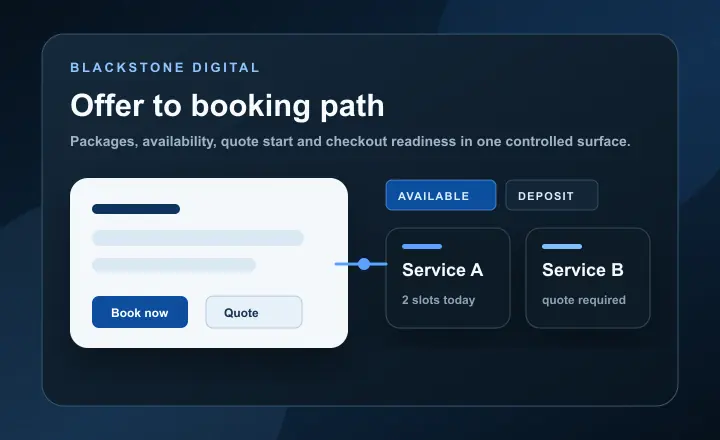
Offer and booking surface
Blackstone Digital structures the public surface so buyers can understand the offer, compare the right option, see the next step and begin a booking, reservation, quote request or checkout path without unnecessary friction.
Commission this when the current site creates interest but leaves customers guessing where to click, what happens next or which option fits their need.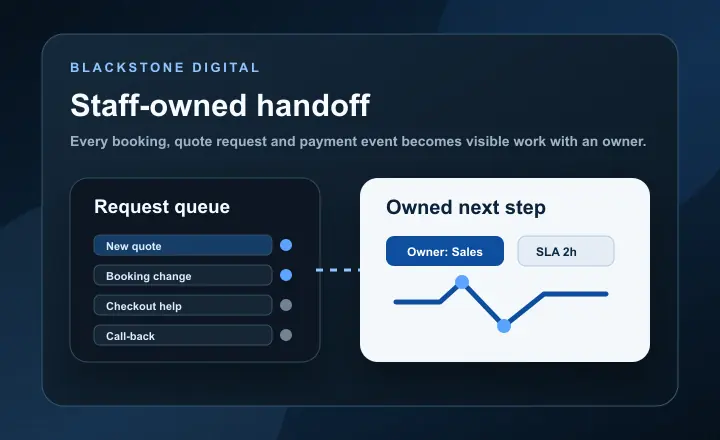
Operations handoff surface
The customer action is only valuable if the team can see the source, context, owner, urgency, status and next responsibility. Blackstone designs the handoff so staff can respond faster and lose fewer high-intent requests.
Commission this when sales, service or operations teams are still relying on manual triage, missed calls, copied notes or unclear follow-up ownership.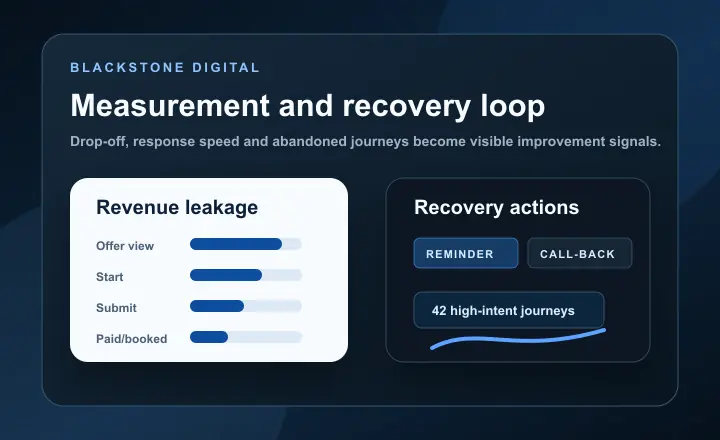
Measurement and recovery surface
A stronger revenue path should not be invisible. Blackstone plans the measurement layer around booking starts, quote quality, checkout completion, response time, abandoned journeys and recovery opportunities.
Commission this when leadership needs a practical loop for improving conversion quality instead of guessing which form, page or handoff is underperforming.External benchmark signals
These benchmarks show why Blackstone treats commerce, booking and quote flows as operating systems, not isolated pages. The numbers are external reference points, not guaranteed outcomes.
Source context: Baymard cart-abandonment research, web.dev performance guidance, Stripe Checkout, Microsoft Bookings and HBR lead-response research.
Decision matrix
| Decision factor | Basic website/form | Single-purpose tool | Blackstone revenue system |
|---|---|---|---|
| Commercial job | Captures interest, but often leaves qualification, ownership and follow-up outside the page. | Solves one action such as calendar booking, checkout or forms, but rarely connects the whole revenue path. | Connects offer clarity, action, confirmation, ownership, recovery and reporting into one controlled customer journey. |
| Customer experience | The visitor may still need to call, wait, compare unclear options or repeat context later. | The action can feel smoother, but the surrounding questions, trust signals and next-step expectations may stay fragmented. | The customer sees the offer, selects the right path, receives confirmation and understands what happens next. |
| Staff ownership | Requests arrive as loose messages, calls or notifications that depend on manual discipline. | The tool records the action, but teams may still copy information into calendars, spreadsheets or CRM notes. | Requests become owned records with status, source, context, response responsibility and recovery paths. |
| Payment readiness | Payment or deposit logic is often postponed, manual or hidden behind a later conversation. | Checkout may work, but offer fit, trust, costs, payment methods and confirmation still need careful design. | Payment, deposit, quote or booking logic is shaped around friction, trust, local payment expectations and confirmation. |
| Recovery path | If the visitor leaves, the business often has no structured way to recover the opportunity. | Some tools support reminders, but the recovery logic may not match the sales process. | Incomplete journeys can be segmented into follow-up, reminder, quote, call-back or abandoned-checkout paths. |
| Measurement | The business sees traffic and form submissions, but not the operational quality of the journey. | The tool may report activity inside its own boundary, not the full path from first interest to follow-up. | Leadership can review offer interest, start rates, completion, response speed, recovery and qualified revenue signals. |
| Blackstone recommendation | Use this only for low-risk brochure traffic or simple inquiry capture. | Use this when one proven action is enough and the surrounding process is already controlled. | Commission the revenue system when the business needs cleaner demand capture, faster handoff, stronger trust and measurable improvement. |
Revenue maturity scale
Customers can understand the offer, price logic, availability, route and expected next step before they act.
The site supports the right action: booking, reservation, quote request, deposit, checkout or call-back.
Every request has source context, status, owner and response responsibility after the customer submits.
The business can review drop-off, response speed, completion quality and recovery opportunities over time.
Digital Systems Review
A review phase can sort the existing website, documents, forms, spreadsheets, customer questions and workflows, then turn them into the first useful build.