
Repeated customer questions
The same explanations are rewritten across email, chat and calls while response quality depends on who is available.

INTELLIGENCE / SERVICE 10
Blackstone Digital designs customer, staff and voice workflows that retrieve trusted information, prepare useful responses, route exceptions and preserve human ownership where judgment still matters.
AI COMMISSION SIGNALS
The same explanations are rewritten across email, chat and calls while response quality depends on who is available.
Approved answers, procedures and service context exist, but staff still search across documents, folders and private messages.
Calls and voicemails create summaries, promises and next actions that are difficult to assign, review and measure.
AI ASSISTANCE SYSTEM PREVIEW

CONTROLLED AI OPERATING SYSTEM
Blackstone does not treat AI as a floating chat box. We connect the request, permitted sources, assistant task, human decision and operating record so the business can see what the system used, what it prepared and where responsibility remains.
Questions, calls and staff requests enter through a known service channel.
The assistant retrieves only the sources and context permitted for the task.
Retrieval, classification, drafting or summarisation stays within an agreed role.
Sensitive, uncertain and consequential outputs pause for accountable review.
The answer, exception and next action move into a visible operating record.
Corrections, unresolved themes and source gaps become evidence for improvement.
The first release names what the assistant may do, what it must never decide, when it must escalate and who can pause or correct it.
FOCUSED AI COMMISSIONS
The first release should solve one repeated communication problem, use a controlled source set and produce evidence the business can inspect before scope expands.

CUSTOMER ASSISTANCE
Blackstone designs a customer-facing assistant around the questions that determine whether a customer continues, waits or leaves. The system can search approved service content, return a structured answer, ask for missing context and pass unresolved intent to staff with the relevant conversation history attached. Current OpenAI Responses capabilities support governed file search, multilingual interaction and approved business-tool calls; Blackstone adds the source ownership, answer policy, tool allowlist, escalation logic and evaluation set required for a real service operation. Prices, contractual commitments, sensitive advice and exceptional cases remain with an accountable employee. The result is not an autonomous chatbot, but a controlled customer-entry layer that protects response quality and makes unanswered demand visible.
Search maintained service content and return the supporting source context.
Ask for missing details and format the request for the receiving team.
Transfer unresolved intent with conversation state, reason and accountable queue.
Repeated questions delay qualification, cool customer intent or consume experienced staff capacity that should be reserved for judgment and exceptions.
A question map, governed knowledge index, customer-assistant prototype, escalation queue and baseline evaluation set.
The assistant does not invent missing policy, issue contractual commitments or provide sensitive advice. Those requests move to an accountable employee with the conversation context attached.
STAFF KNOWLEDGE AND DRAFTING
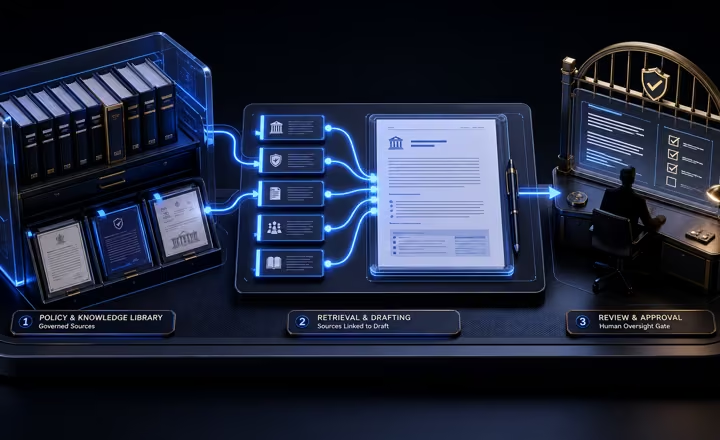
Blackstone builds a permission-aware staff workspace that can search maintained policies, service notes, approved templates and selected business systems, then prepare a cited answer, comparison, summary or first draft. Current OpenAI Responses capabilities can combine file search with approved tools, but the operational value comes from the controls around them: each result shows its source, weak or outdated material becomes visible and a named employee remains responsible for release. Access follows the staff member's role, write actions stay allowlisted and external communication is never sent merely because a model prepared it. Corrections become a managed knowledge backlog and part of the evaluation set. Fragmented expertise is converted into a reusable operating asset without removing professional ownership.
Search only sources and systems allowed for the staff role and task.
Prepare answers, comparisons, summaries and drafts with reviewable source references.
Use allowlisted business actions while release and consequential writes remain controlled.
Experts repeatedly reconstruct approved answers, while newer colleagues depend on informal guidance and cannot see which source should control the decision.
An access map, maintained source index, cited retrieval prototype, review workflow and correction register.
The workspace cannot cross role permissions, write silently to connected systems or release external communication solely because a model prepared it.
VOICE INTAKE AND FOLLOW-UP
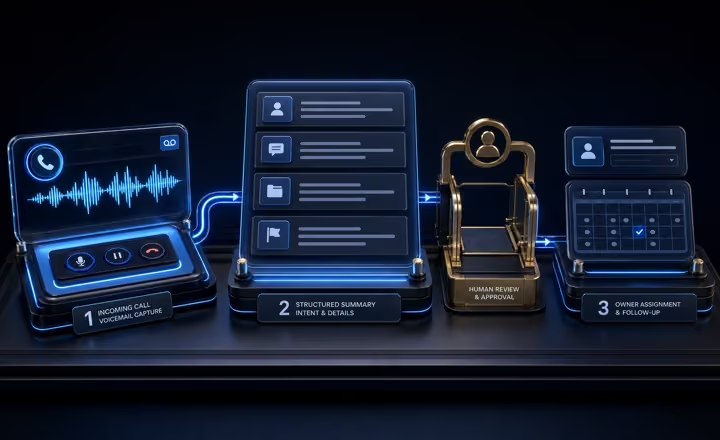
Blackstone designs a voice workflow around the OpenAI Realtime API rather than treating transcription as the finished product. Current realtime models can sustain speech-to-speech interaction, handle interruptions, call approved tools and operate through browser, application or SIP phone connections. Streaming transcription and translation can support live notes or multilingual paths where the operating case requires them. Blackstone defines the call states, AI disclosure, recording notice, consent, identity checks, tool permissions, human transfer, structured summary and follow-up ownership before release. The system may retrieve approved information or prepare a next action, but sensitive advice, contractual commitments, record-changing actions and uncertain requests pause or transfer. The commercial objective is faster ownership and fewer silent follow-up gaps, not autonomous handling of every call.
Support speech-to-speech interaction, interruptions and recovery over browser, application or SIP.
Create streaming transcription and a structured summary as the call progresses.
Call permitted services and transfer exceptions to staff with the relevant context.
Call context, commitments and owner assignment disappear between voicemail, notes, inboxes and calendars, leaving customers without a visible next action.
A call-state map, consent model, realtime prototype, tool allowlist, human transfer route and follow-up ownership board.
AI disclosure, recording consent, identity checks and consequential actions remain explicit gates. Sensitive, uncertain or out-of-policy requests pause or transfer.
AI COMMISSION MATRIX
The right first project is defined by one operating pressure, a source boundary and a review model, not by the broadest possible feature list.
DELIVERY ROADMAP
Blackstone separates the first useful commission from later expansion so the business can inspect sources, review pressure and operating value before increasing access or autonomy.
Choose the repeated communication problem and the decision owner.
Define sources, prohibited actions, review rules and escalation states.
Link the smallest required knowledge, channel and operating record.
Test useful answers, weak outputs, corrections and exception handling.
Assign source ownership, monitoring, pause routines and improvement cadence.
AI SYSTEMS REVIEW FAQ
The first review is designed to decide whether an assistant is justified, what it may access and where human judgment must remain visible.
No. Blackstone narrows the source set, requires visible limits and designs review or escalation around outputs that are uncertain, sensitive or consequential. Accuracy claims must be tested against the actual use case and source quality.
Not necessarily. A focused pilot can begin with a small approved source set if it covers one valuable question pattern. Missing, conflicting or outdated sources are treated as operating findings rather than hidden by the assistant.
Customer commitments, sensitive advice, record changes, permission changes and unusual requests should remain behind a named review gate unless the business has evidence and authority for a different boundary.
Recording, transcription and retention depend on the channel, consent model, location and business policy. Blackstone maps those constraints before designing the summary and follow-up path.
The smallest useful connection may be a website form, document store, inbox, CRM-light record, staff portal or telephony service. Integrations are selected only when they support the bounded use case and its ownership model.
The handover names source owners, review rules, correction routes, evaluation signals and a pause procedure. Expansion is commissioned only after the business can inspect how the first workflow behaves.
AI SYSTEMS REVIEW
Blackstone will identify the narrowest useful assistant, the sources it may use, the decisions that must remain visible and the evidence needed before expansion.